Inquiry Activities
Welcome to Your Design Journey!
Now that you understand your challenge, it's time to begin designing your inclusive playground. Over the next three activities, you will investigate the problem, develop creative ideas, and create a solution that helps every child play without limits. Remember to work together, ask questions, and use feedback to improve your design along the way.
Throughout these three inquiry activities, you will follow the Design Thinking process to investigate a real-world problem, generate creative ideas and develop an inclusive playground solution. Each activity builds on the previous one, helping you refine your ideas through collaboration, feedback and reflection.

Activity 1: Investigate & Define
Students research inclusive playgrounds, identify users' needs, observe the school playground, and gather information.

Activity 2: Generate & Design
Students brainstorm, sketch, label, and refine their playground designs using feedback.

Activity 3: Produce, Test & Evaluate
Students construct a 3D playground model, test their design against the success criteria, gather peer feedback and evaluate how effectively their playground meets the needs of all users. Students then refine their designs before presenting their final solution. Students present their final solution to the class and explain how their design responds to the original design challenge.
Work Samples
The following work samples demonstrate how student thinking develops throughout the project. Each sample aligns with the inquiry activities and Australian Curriculum content descriptors, showing the progression from investigation to design and evaluation.
Formative Assessment
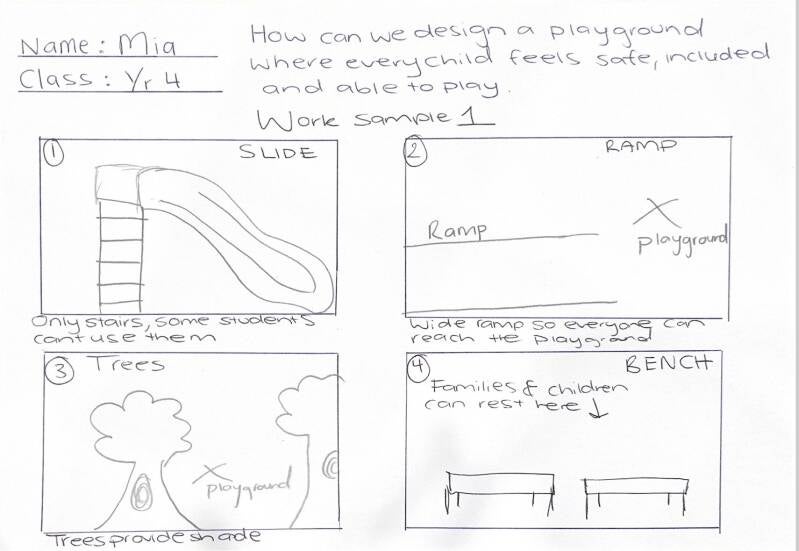
Work Sample 1:
What makes a playground inclusive?
✔ Wide pathways
✔ Accessible equipment
✔ Quiet sensory spaces
Problems we found:
- Only one swing.
- Not enough shade
- No sensory play equipment.
- Some equipment cannot be reached by everyone.
We want to design a playground where every child can play safely, have fun, and feel included. Students use their investigation findings to identify the design challenge before beginning to generate possible solutions.
Content Descriptor: AC9TDE4P01 – Investigate needs or opportunities for designing and the materials, components, tools, equipment and processes needed to create designed solutions.
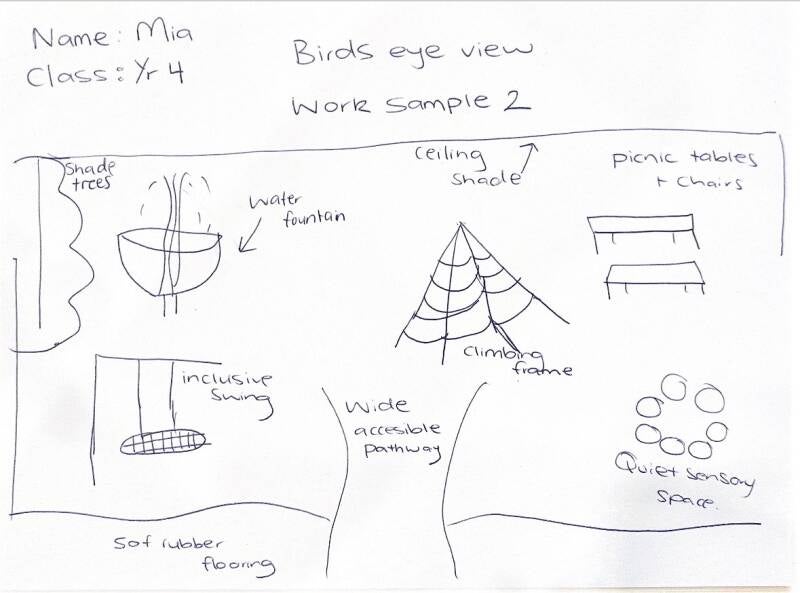
Work Sample 2:
Accessible ramp
Children who use wheelchairs or have limited mobility can reach the playground safely.
Sensory garden
Different textures, colors, and sounds create a calm space for children who enjoy sensory play.
Wide pathways
They make it easy for wheelchairs, prams, and everyone else to move around the playground.
Rubber flooring
It helps reduce injuries if someone falls while playing.
Sustainability
My playground includes:
Trees for shade, Recycled materials, Native plants, Water refill station
I think my playground is inclusive because children with different abilities can play together safely. I included quiet spaces, accessible equipment, and lots of places for families to enjoy together.
Formative Assessment: Content Descriptor: AC9TDE4P02 – Generate and communicate design ideas using sketches, models, and suitable representations.
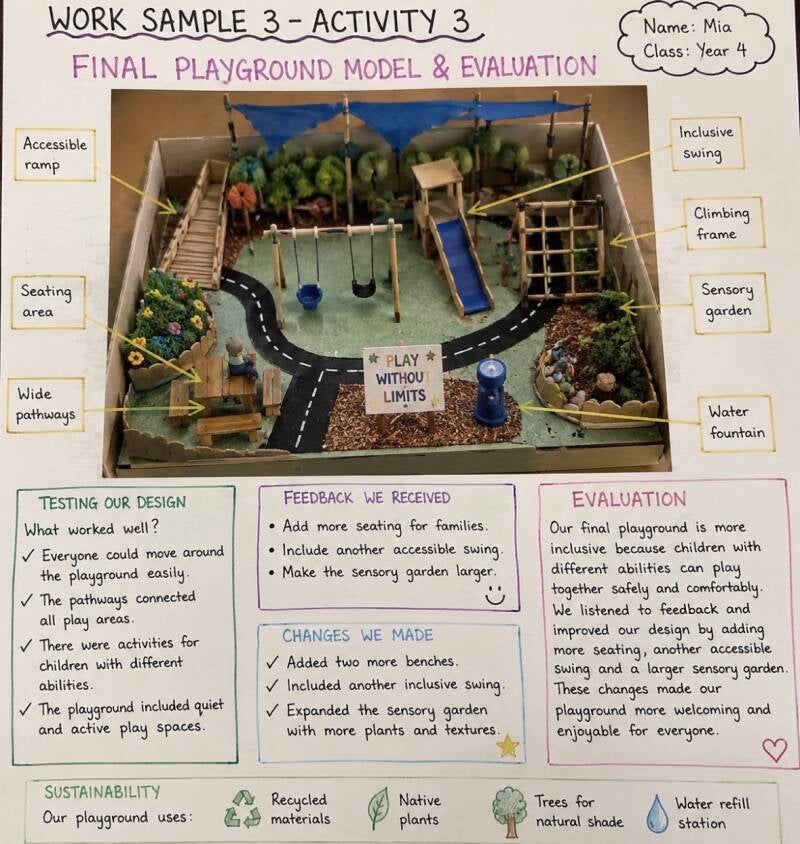
Work Sample 3:
Assessment Type: Summative Assessment
Content Descriptor: AC9TDE4P03 – Produce and test designed solutions, safely using appropriate materials, tools, and equipment, and use evaluation to refine designs.
Reflection: After making these improvements, our final design better met the success criteria by providing greater accessibility, safety and opportunities for all children to participate. The feedback process helped us improve our design and showed us that effective designers continually evaluate and refine their ideas.